Tag: inburgering

  • Dutch Civic Integration: Module Arbeidsmarkt en Participatie (MAP)

    If you’re going through the Dutch civic integration process (inburgering) , you’ve probably heard about Module Arbeidsmarkt en Participatie (MAP). Like PVT, it’s one of the required components under the Wet Inburgering 2021 (Civic Integration Act 2021).

    In this post, I’ll explain what MAP training is and share my own experience attending it.

    What is MAP Training?

    MAP stands for Module Arbeidsmarkt en Participatie, which translates to Labour Market and Participation Module. It is designed to help newcomers:

    • Understand the Dutch labour market
    • Learn how to search and apply for jobs
    • Discover different ways to participate in society (e.g., work, volunteering, or education)
    • Create a personal plan for their career or social participation in the Netherlands

    MAP is a required part of integration for most newcomers, especially if you’re on the B1 or Z route.

    According to my contact person in my gemeente, you can only get an exemption from MAP if you’re working in a paid job in a language-rich environment, where Dutch is used regularly.

    For certainty, contact your caseworker or your contact person at the gemeente to confirm what applies to your specific situation.

    My Personal Experience

    I recently completed MAP and attended a total of 8 weekly sessions, each lasting from 9:30 to 11:30 every Wednesday. There were approximately 25 people in my group, with a combination of B1-route and Z-route participants.

    Each session focused on a different topic related to working and participating in the Netherlands. Some of the modules we covered included:

    • How to write a Dutch-style CV
    • How to read and apply to vacatures (job vacancies)
    • Insights into the Dutch job market and working culture.

    We also spent time reflecting on our personal strengths and skills. We were encouraged to think about our qualities like being analytical, caring, reliable, patient or practical, and how those qualities might fit into different job sectors. This helped us consider which roles match our education background and previous work experience. It was a helpful way to connect who we are with the kind of work we may want to pursue in the future.

    One of the sessions was especially interesting. We visited a local institution that provides support for entrepreneurs and learned more about starting a business in the Netherlands. Even though I’m not planning to become self-employed, it was helpful to know that this option exists.

    In our final session, each of us gave a short presentation about our personal goals and what we learned throughout the training. We presented it in front of the group and some representatives from the gemeente (municipality). There was also a kind of mock interview or kennismaking, where we had an informal conversation with the gemeente representative about our future plans.

    At the end, we all received a certificate of completion, which felt like a nice milestone!

    Do You Have to Work or Volunteer After MAP?

    That depends on your personal situation. In my case, because I’m here on a partnerschap visum (partner visa), I am not required to do the practical part such as working or volunteering. Attending and completing the MAP sessions was enough for me to fulfill this requirement.

    If you’re on a different visa (or a statushouder), you may have to take more practical steps afterward, such as finding volunteer work or starting a work trajectory.

    Again, for certainty, contact your caseworker or your contact person at the gemeente to confirm what applies to your specific situation.

    Final Thoughts

    Overall, I found MAP to be a positive and valuable experience. It helped me better understand the Dutch working environment and gave me more confidence about how things work here.

    One thing I noticed was that the training was delivered in a one-size-fits-all format, with participants from both the B1 and Z routes mixed together. Because there were significant differences in Dutch language skills and learning pace, some participants struggled to communicate effectively or fully grasp the material. As a result, some people may not have gained the full benefit of the training or may have missed the intended learning outcomes.

    In my opinion, it would be more effective if future MAP sessions were divided by route or language level, allowing everyone to participate more comfortably, engage better and get the most out of the program.


    Whether your goal is to join the Dutch workforce, explore volunteer opportunities or gain insight into how Dutch society works, MAP provides a helpful foundation.

    Have you already taken MAP? Or are you about to start? Feel free to share your experience or ask questions in the comments!
  • Moving to The Netherlands: A Simple Guide to Settling In

    Moving to the Netherlands is an exciting journey, but settling in smoothly requires a few important steps. This blog post serves as a concise and informative guide for newcomers, providing practical insights to help you transition seamlessly into Dutch society. From civic integration to everyday essentials, here’s what you need to know:


    Dutch Civic Integration (Inburgering)

    If you are required to integrate (inburgeringsplichtig), you must complete the Dutch civic integration process within three years. Here’s what to expect:

    A) Letter from Dienst Uitvoering Onderwijs (DUO)

    If you have to integrate under the Integration Act 2021, you will receive a letter from DUO confirming your integration requirement. You will receive the letter only after you have your burgerservicenummer (BSN), verblijfsvergunning (resident permit) and registered with your gemeente (municipality).

    Read: Checklist Before and After Moving to the Netherlands

    B) Broad Intake and Personal Integration & Participation Plan (PIP)

    After receiving your DUO letter, your municipality will invite you for an intake interview. It’s a simple conversation to understand your background. You’ll also need to take a Leerbaarheidstoets (Learning Ability Test) – a basic logic test to assess your learning ability.

    Based on this, the municipality will create a Personal Integration and Participation Plan (PIP), outlining your learning path and required exams. Your integration officially starts once your PIP is established, and you receive another letter from DUO with your integration deadline.

    C) Learning Routes

    There are 3 learning routes:

    • B1 Route: Prepares you for work (paid or volunteer). You’ll need to pass Dutch language exams at B1 level and a knowledge test.
    • Educational Route: For young people who want to study at MBO, HBO or university level. Language exams (B1 or B2) and a knowledge test are required.
    • Self-Reliance Route (Z-route): For those who find the other routes too difficult. You may need to take language tests, but the main assessment is an interview with the municipality.

    Your PIP will list the exams you need to take. These exams aren’t free, so plan for the costs. You can find study resources and exam schedules on the official civic integration website.

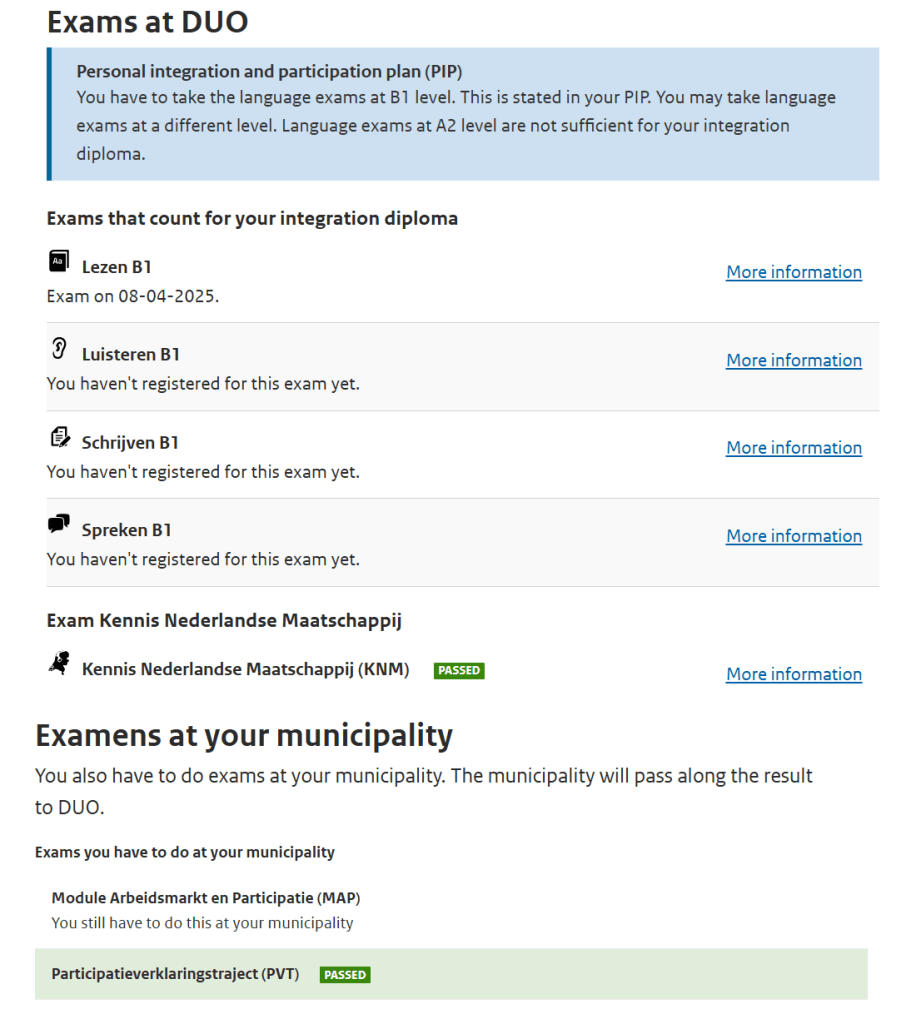
    My experience: I’m following the B1 route. My PIP requires me to pass Dutch language exams (Listening, Reading, Speaking and Writing) and Knowledge of Dutch Society (Kennis Nederlandse Maatschappij, KNM) at DUO. Meanwhile, the Module Arbeidsmarkt en Participatie (MAP) and Participatieverklaringtraject (PVT) must be completed through my municipality.

    From Mijn Inburgering site. It shows the list of exams you need to take along with your results.

    Learn the Language

    Learning Dutch is part of the integration process. It also helps in daily life and securing job. You can learn through:

    📚 Paid Options – Enroll in language schools, hire a private tutor or take online courses.

    💬 Free Options – Join Taalcafé or Taalhuis programs at your local library for casual language practice.

    📖 Self-Study – Use language apps, books, and online resources to learn at your own pace.

    Check out my recommendation of study resources in Useful Links for Learning Dutch and Top Resources to Learn Dutch Effectively for Beginners


    Diploma Evaluation & Kickstarting Your Career

    Landing a job in the Netherlands can be both exciting and challenging. Before diving in, make sure your visa allows you to work. If you’re eligible, start exploring job opportunities through online platforms and networking events. The job hunt can be a rollercoaster – some find success quickly, while others face hurdles. Stay patient and persistent!

    If you’re torn between continuing your education or entering the job market, check out my guide: Should You Pursue a New Degree or Focus on Job Hunting (When Starting Fresh Abroad)?

    Diploma Evaluation (Diplomawaardering)

    In certain professions, having your foreign diploma officially evaluated is essential. Organizations like Nuffic and International Credential Evaluation (IDW) assess your qualifications and compare them to the Dutch education system.

    Start this early in your integration. Even if you’re not actively job hunting, getting your diploma evaluated is a smart move – you never know when an opportunity might arise!

    ✔️ The evaluation process is free for most immigrants.
    ✔️ Employers use these assessments to understand your education level.

    Taking this step early can give you an edge when the right job opportunity comes along!


    Everyday Essentials to Make Your Life Easier in the Netherlands

    🚆 OV-chipkaart – Your key to public transport! Use it for trains, buses, trams and the metro.

    🚲 Bicycle – The ultimate Dutch way to get around. Invest in a sturdy (but not necessarily new) bike and make sure to learn the traffic rules!

    📱 Must-Have Apps

    • Buienradar – Stay ahead of sudden rain showers (because Dutch weather loves surprises!).
    • NS & 9292 – Plan your trips by train, bus, tram or metro with ease.
    • Marktplaats – Buy and sell second-hand goods, from furniture to bikes.

    👥 Online Support Groups – Join expat communities on Facebook for tips, advice, and local connections.


    Moving to the Netherlands comes with its challenges, but with the right preparation, you’ll settle in smoothly. Wishing you a smooth and exciting start to your new adventure – Welcome to the Netherlands! 🇳🇱😊