Categorie: Life Abroad

  • Moving to The Netherlands: A Simple Guide to Settling In

    Moving to the Netherlands is an exciting journey, but settling in smoothly requires a few important steps. This blog post serves as a concise and informative guide for newcomers, providing practical insights to help you transition seamlessly into Dutch society. From civic integration to everyday essentials, here’s what you need to know:


    Dutch Civic Integration (Inburgering)

    If you are required to integrate (inburgeringsplichtig), you must complete the Dutch civic integration process within three years. Here’s what to expect:

    A) Letter from Dienst Uitvoering Onderwijs (DUO)

    If you have to integrate under the Integration Act 2021, you will receive a letter from DUO confirming your integration requirement. You will receive the letter only after you have your burgerservicenummer (BSN), verblijfsvergunning (resident permit) and registered with your gemeente (municipality).

    Read: Checklist Before and After Moving to the Netherlands

    B) Broad Intake and Personal Integration & Participation Plan (PIP)

    After receiving your DUO letter, your municipality will invite you for an intake interview. It’s a simple conversation to understand your background. You’ll also need to take a Leerbaarheidstoets (Learning Ability Test) – a basic logic test to assess your learning ability.

    Based on this, the municipality will create a Personal Integration and Participation Plan (PIP), outlining your learning path and required exams. Your integration officially starts once your PIP is established, and you receive another letter from DUO with your integration deadline.

    C) Learning Routes

    There are 3 learning routes:

    • B1 Route: Prepares you for work (paid or volunteer). You’ll need to pass Dutch language exams at B1 level and a knowledge test.
    • Educational Route: For young people who want to study at MBO, HBO or university level. Language exams (B1 or B2) and a knowledge test are required.
    • Self-Reliance Route (Z-route): For those who find the other routes too difficult. You may need to take language tests, but the main assessment is an interview with the municipality.

    Your PIP will list the exams you need to take. These exams aren’t free, so plan for the costs. You can find study resources and exam schedules on the official civic integration website.

    My experience: I’m following the B1 route. My PIP requires me to pass Dutch language exams (Listening, Reading, Speaking and Writing) and Knowledge of Dutch Society (Kennis Nederlandse Maatschappij, KNM) at DUO. Meanwhile, the Module Arbeidsmarkt en Participatie (MAP) and Participatieverklaringtraject (PVT) must be completed through my municipality.
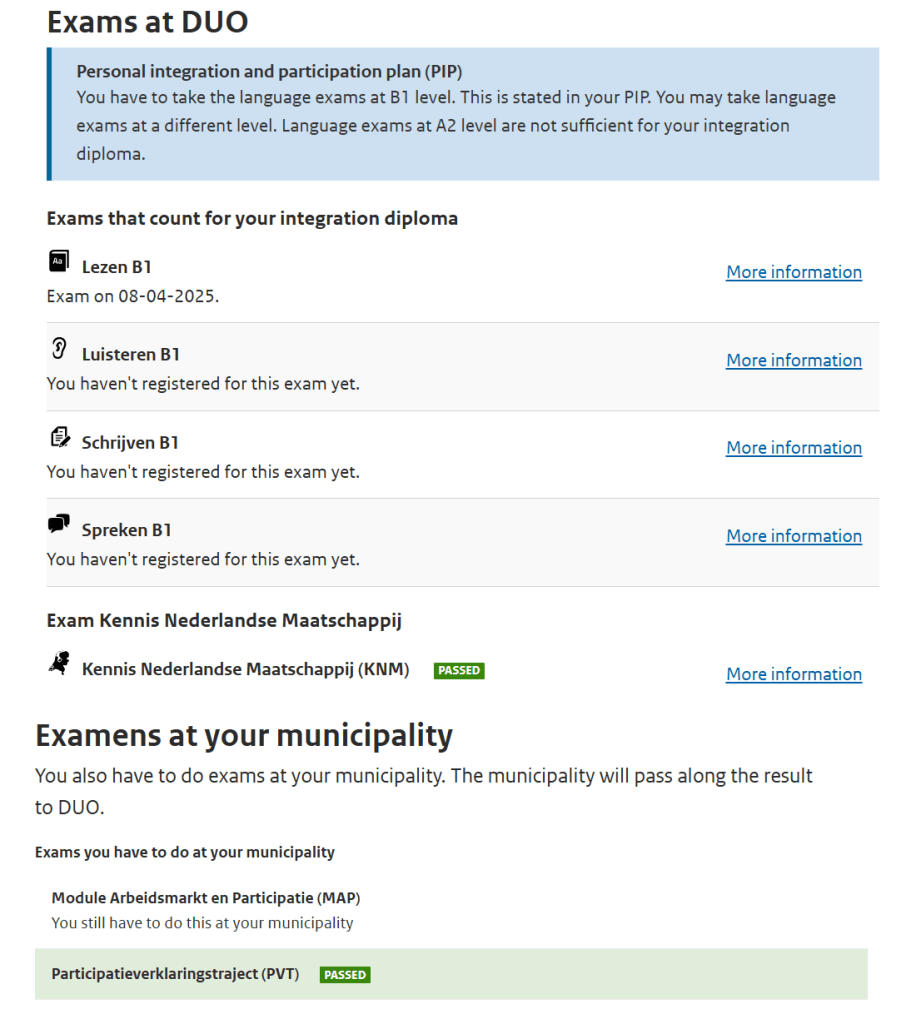
    From Mijn Inburgering site. It shows the list of exams you need to take along with your results.

    Learn the Language

    Learning Dutch is part of the integration process. It also helps in daily life and securing job. You can learn through:

    📚 Paid Options – Enroll in language schools, hire a private tutor or take online courses.

    💬 Free Options – Join Taalcafé or Taalhuis programs at your local library for casual language practice.

    📖 Self-Study – Use language apps, books, and online resources to learn at your own pace.

    Check out my recommendation of study resources in Useful Links for Learning Dutch and Top Resources to Learn Dutch Effectively for Beginners


    Diploma Evaluation & Kickstarting Your Career

    Landing a job in the Netherlands can be both exciting and challenging. Before diving in, make sure your visa allows you to work. If you’re eligible, start exploring job opportunities through online platforms and networking events. The job hunt can be a rollercoaster – some find success quickly, while others face hurdles. Stay patient and persistent!

    If you’re torn between continuing your education or entering the job market, check out my guide: Should You Pursue a New Degree or Focus on Job Hunting (When Starting Fresh Abroad)?

    Diploma Evaluation (Diplomawaardering)

    In certain professions, having your foreign diploma officially evaluated is essential. Organizations like Nuffic and International Credential Evaluation (IDW) assess your qualifications and compare them to the Dutch education system.

    Start this early in your integration. Even if you’re not actively job hunting, getting your diploma evaluated is a smart move – you never know when an opportunity might arise!

    ✔️ The evaluation process is free for most immigrants.
    ✔️ Employers use these assessments to understand your education level.

    Taking this step early can give you an edge when the right job opportunity comes along!


    Everyday Essentials to Make Your Life Easier in the Netherlands

    🚆 OV-chipkaart – Your key to public transport! Use it for trains, buses, trams and the metro.

    🚲 Bicycle – The ultimate Dutch way to get around. Invest in a sturdy (but not necessarily new) bike and make sure to learn the traffic rules!

    📱 Must-Have Apps

    • Buienradar – Stay ahead of sudden rain showers (because Dutch weather loves surprises!).
    • NS & 9292 – Plan your trips by train, bus, tram or metro with ease.
    • Marktplaats – Buy and sell second-hand goods, from furniture to bikes.

    👥 Online Support Groups – Join expat communities on Facebook for tips, advice, and local connections.


    Moving to the Netherlands comes with its challenges, but with the right preparation, you’ll settle in smoothly. Wishing you a smooth and exciting start to your new adventure – Welcome to the Netherlands! 🇳🇱😊

  • Moving to the Netherlands: Visa Requirements & Essential Checklist

    Relocating to the Netherlands is an exciting opportunity, but before you pack your bags, it’s crucial to understand the visa requirements and prepare accordingly. This guide will help you navigate the process smoothly and ensure you have everything in place before and after your move.

    Visa Type & Requirements

    Before embarking on your journey to the Netherlands, determining the right visa type is essential. The requirements depend on your nationality, the purpose of your stay (e.g., work, study, or family reunification), and the length of your stay. Some common visa types include:

    • Short Stay Visa (Schengen Visa): For stays of up to 90 days, typically used for tourism, business trips, or short-term studies.
    • MVV (Provisional Residence Permit): Required for those planning a long-term stay, depending on your nationality and reason for moving.
    • Residence Permit: Issued after arrival for specific purposes, such as employment, studies, or family reunification.

    Visit the Dutch Immigration and Naturalisation Service (IND) website to identify the correct visa for your needs and gather the necessary documents.

    Checklist: Before and After Moving
    A) Before Moving (In Your Home Country)

    1. Bank Card
      • Inform your bank of your international move to ensure seamless transactions abroad.
      • Check for any international fees or consider opening an account that supports international banking.
    2. Subscriptions
      • Cancel or update subscriptions, such as mobile phone plans, internet, and streaming services, to avoid unnecessary costs.
    3. Insurance
      • Ensure your travel insurance covers the transition period.
      • Research health insurance options in the Netherlands, as it is mandatory for residents.
    4. Packing List
      • Pack seasonal clothing and essentials, considering the Netherlands’ unpredictable weather.
      • Don’t forget adapters for European plugs and voltage requirements.
    5. Important Documents
      • Keep originals and digital copies of:
        • Birth certificate
        • Academic certificates
        • Letters from the embassy or IND
        • Passport and visa-related documents

    B) After Moving (In the Netherlands)

    1. Get a New SIM Card
      • Purchase a Dutch SIM card for local communication and data.
    2. Register with the Gemeente (Municipality)
      • Make an appointment to register your residence and obtain your Burgerservicenummer (BSN).
    3. Residence Permit
      • Wait for the letter from IND confirming your residence permit is ready.
      • Schedule an appointment with IND to collect it.
    4. Apply and Activate DigiD
      • DigiD is your digital identity for accessing Dutch government services. Apply online after receiving your BSN.
    5. Set Up MijnOverheid Account
      • This portal provides access to personal government correspondence and records.
    6. Open a Bank Account
      • Choose a Dutch bank to manage finances locally. BSN and proof of address are typically required.
    7. Get Health Insurance
      • Dutch law requires health insurance within four months of registering at the gemeente. Compare providers to find suitable coverage.
    8. Register with a Huisarts (General Practitioner) and Tandarts (Dentist)
      • Search for a local huisarts and tandarts and register to ensure access to medical and dental care when needed.

    Moving to the Netherlands is an exciting journey, but it requires careful planning and preparation. By understanding the visa requirements and following the checklists provided, you can ensure a seamless transition to your new life in this beautiful country. So, prepare your documents, pack your bags, and get ready to embrace the Dutch way of life!

    And also remember, moving to the Netherlands is just the beginning – truly settling in is what makes it home. My insightful guide walks you through the essential steps for a smooth transition, especially for newcomers on a partnership visa. Read Moving to The Netherlands: A Simple Guide to Settling In for essential information on everything from civic integration and diploma evaluation to everyday essentials.

    Wishing you a smooth and exciting start to your new adventure – welcome to the Netherlands! 🇳🇱😊


    Have questions or tips about moving to the Netherlands? Share your thoughts in the comments below!

  • Building Meaningful Connections and Finding Friendships in a New Country

    One of my biggest challenges when moving to the Netherlands was building a solid network. People-networking, that is. Moving to the Netherlands left me feeling isolated – until I learned that true connection is about quality, not quantity. And I also learned that friendship doesn’t necessarily mean networking and networking doesn’t always mean friendship. This is my personal journey of how I built meaningful connections and found friendships here in my new country.

    The Web That Unraveled

    Back in my home country, I had everything figured out. Need a good tailor? I knew exactly where to go. Looking for advice? I had a list of people to call. My network was built over years, starting from my student days and expanding into work, hobbies and community circles. Friends of friends, contacts from various organizations, you name it, I had it. Then I moved to the Netherlands, and suddenly my carefully woven web of connections was gone.

    My anxiety skyrocketed. What if I needed help? What if I had no one to turn to? What if I got lost, both literally and figuratively? And to make things even trickier, I didn’t speak the language (yet). The language felt like a wall I couldn’t climb, and the streets, though picturesque, felt cold and unfamiliar.

    Determined to do something about it, I started attending the taalcafé at the local library. It was a safe space to practice Dutch and meet others in the same boat. For a while, it worked. I made friends, shared laughs and even learned a lot of Dutch phrases. But just when I started getting comfortable, people started drifting away. Some got too busy, others moved away and some simply lost interest. Eventually, I stopped going too.

    The Illusion of Familiarity

    I also tried making friends through family connections. While many were genuinely kind and welcoming, these relationships sometimes felt a little off. These relationships often carried an unspoken weight – a sense of obligation rather than genuine connection. It wasn’t the same as the friendships I’d built back home, where bonds grew organically over shared experiences.

    Then came the cultural networking. More than once, random Asian aunties would approach me and bombard me with questions. The questions came rapid-fire: “Where are you from? Are you married? What does your husband do? Any kids? Why no kids?”  Their questions were warm but suffocating. Though I knew it came from a place of cultural familiarity, it didn’t feel like friendship. And they seemed to know everything about me, or at least they thought they did. I’m definitely not a fan of being “interrogated” by strangers.

    Worse were the groups that promised camaraderie but delivered competition. Echt! At first, it was all about sticking together… until it turned into a game of one-upmanship: “My husband this and that! Check out my new LV! We just bought a new car!” Social media flexing, status comparisons – it was so exhausting! Their humblebrags piled up like unwashed dishes. I eventually cut ties with all of them.

    Four Women, One Kitchen and the Art of Imperfection

    Still, along the way, I found a small, close-knit group of friends. Just the four of us girls, none of whom are Dutch (It’s often said that the Dutch can come across as reserved or less outwardly friendly). We were in the same boat, all navigating the same challenges and all determined to make the best of it. There were no pretenses, no comparisons, just genuine connection.

    We’d meet for girls’ days out, laughing over stroopwafels and coffee, or crowding into someone’s kitchen to cook meals that tasted like home – even if the recipes didn’t always turn out right. Birthdays and milestones became excuses to celebrate. Over shared meals, we traded stories that felt like lifelines. One friend confessed how much she missed the fresh seafood from her country, her voice tinged with nostalgia. Another admitted she’d become a regular at the kringloop, stocking up on second-hand treasures for her daughter. And then there was the one who juggled a work shift, gym sessions, and Dutch lessons, her days a blur of exhaustion and determination. In those moments, our differences didn’t matter. What mattered was the unspoken understanding that we were all navigating the same storm, just in different boats.

    We became a patchwork family. Not because we shared blood, cultures or borders, but because we shared vulnerability. It’s not about quantity but quality, and I’m especially grateful for this newfound friendship in this foreign land. These friendships became my anchor in a sea of uncertainty.

    The Taalcafé Redemption

    Months later, I decided to give the taalcafé another shot. This time, I went in with a different mindset. I didn’t just attend. I leaned in. Instead of waiting for connections to come to me, I put myself out there. I started attending the taalcafé on a regular basis, made an effort to engage with others and became more proactive.

    To my surprise, the coordinator and volunteers at the taalcafé took notice. When I mentioned that I was applying for an internship at a local organization, the coordinator quietly sent a reference email on my behalf. I hadn’t asked for it – she just did it. I never saw the reference coming. But that’s the thing about organic connections: they grow in quiet soil.

    That small act of kindness reminded me that networking isn’t about forcing connections, chasing after friendship or sticking to people just because of shared background. It’s about showing up, being genuine and letting things unfold naturally.

    The Lesson I Carry Forward

    Looking back, I realize how much I’ve grown. Building a network in a foreign country isn’t about replicating what you had back home. It’s about embracing the unknown, being open to new experiences, and finding joy in the unexpected. Networking abroad isn’t about collecting contacts like stamps. It’s about planting seeds, not knowing which will bloom. The Dutch aren’t “unfriendly” – they’re curated. Relationships deepen slowly here, like tulip bulbs under frost. And that’s okay.

    I’m still figuring things out, still building connections. But one thing’s for sure – I’m no longer letting my fear of the unknown hold me back. I’m mostly curious now, actually. Who will I meet next? What new adventures await?

    So, dear reader, how about you?  Have you ever found yourself starting over in a new place? Ever bonded with someone over a kitchen disaster? Felt both seen and lost in a new place? How did you build your network? I’d love to hear your story – because in the end, we’re all navigating life’s twists and turns together.

    P.S. If you’re in the Netherlands, try the taalcafé. And bring extra stroopwafels. Trust me.

  • Finding Balance, Coping with Job Uncertainty and Thriving in Transition

    Moving to a new country is like stepping into a whole new world, and it’s no surprise that it feels tough, especially with language barriers and finding work in unfamiliar places. When you’ve had a high-paying, fulfilling job back home, taking on random jobs in a new place can feel like a hit to your pride. You’re not alone in feeling this way; many people experience that same dip in confidence during a big move.

    But here’s the thing: every experience has its value, and sometimes the small steps forward – taking temporary roles, for example – are what actually get you to where you want to be in the long run. It can be helpful to see each job, no matter how “random,” as a stepping stone. These roles can help you learn the local language, build connections, and gradually adjust to the new environment.

    Winter is indeed on the way, and I completely get that it’s adding to your stress. If being away from home is wearing you down, going back for the winter could be a great idea. It might give you time to rest, refocus, and come back with a fresh mindset for the spring. The other option is exploring ways to connect with people locally, even in small ways like joining language classes or expat groups. Often, these are lifelines during winter months.

    If possible, you might also want to explore remote work options that allow you to leverage your skills and background without the need to be proficient in the local language. Freelancing or remote roles could give you the flexibility to keep working in your field, which might boost your confidence and make the transition easier.

    Ultimately, the most important thing is to give yourself permission to feel frustrated and overwhelmed but also the space to recharge. You don’t have to do everything perfectly right now. Progress doesn’t always mean being in the perfect job or environment – it means taking care of yourself and adapting step by step. The winter, the slow job market, and the language barriers are just temporary. They won’t define you in the long run. You’re in the midst of a transition that will lead you to something better. Just keep moving forward, even if it’s at a slower pace.