Tag: everyday life in the netherlands

  • Summer on the Rails: Unlimited NS Pass + Museumkaart

    Last summer I paid €49 a month to ride almost every train in the Netherlands and I paired it with a Museumkaart to give every trip a destination. Here is how I used both, what it cost me, and whether I would do it again.

    If you are new to the Netherlands or still deep in your inburgering studies like I was not too long ago, this combination is one of the best ways to see the country without watching your bank balance.

    What the summer pass actually is?

    The pass is called Nederland Dal Vrij Trein and it gave unlimited second-class travel on domestic trains for €49 per month. It went on sale on 15 June 2026 and was valid until 31 August 2026, which covers the whole Dutch summer holiday.

    The catch is the word dal, off-peak. On weekdays you can travel before 06:30, between 09:00 and 16:00, and after 18:30. On weekends you can travel all day. It covers NS and the private rail operators.

    For comparison, NS’s regular year-round Dal Vrij subscription costs well over twice as much, so the summer price was a real discount. Demand was huge: NS reported roughly 365,000 people using the pass.

    How I used it?

    My rule was simple: plan around the off-peak window, then go far.

    • Weekend city trips to Utrecht, Haarlem, Rotterdam, Den Haag, etc. with no need to check fares.
    • Weekday outings – I left after 09:00 and came home after 18:30 to stay inside the off-peak hours
    • Spontaneous trips – because the marginal cost of a trip was zero, I could say yes to a last-minute plan

    The biggest mindset shift was that distance stopped mattering. A trip across the country felt as cheap as a trip to the next town, which changed what I considered worth doing in a day.

    Adding the Museumkaart

    The train pass got me to a city, the Museumkaart gave me a reason to get off. It is an annual card that gives free entry to around 500 museums in the Netherlands. The adult price in 2026 is €75 per year and under-18 cards cost €39.

    The two work well together. I picked a museum first, then used the NS app to plan the journey, instead of the other way around.

    Tips from my experience:

    • Many museums now require an online time slot, even with a Museumkaart. Book ahead, especially on weekends.
    • Not every museum is included, and some only offer a discount. Check the museum’s own page before you travel.
    • A museum visit often fits neatly inside the off-peak window, so you rarely have to rush a train home.

    Was it worth it? For me, yes. I took the train every Wednesday (my day off) and every weekend, which is exactly when the pass is valid. That steady routine is what made the €49 a month easy to justify.

    The Museumkaart is the easier one to judge. At €75 it pays for itself after a handful of visits, since many Dutch museum tickets cost €15 to €25 each. The train pass is the bigger gamble, because you only win if you travel off-peak often enough to beat paying per trip.

    Will I do it again? Yes. The pass was a temporary summer offer, so keep an eye on NS announcements for next year. In the meantime, the Museumkaart is a good year-round habit and it pairs well with any NS subscription or discount.
  • Moving to The Netherlands: A Simple Guide to Settling In

    Moving to the Netherlands is an exciting journey, but settling in smoothly requires a few important steps. This blog post serves as a concise and informative guide for newcomers, providing practical insights to help you transition seamlessly into Dutch society. From civic integration to everyday essentials, here’s what you need to know:


    Dutch Civic Integration (Inburgering)

    If you are required to integrate (inburgeringsplichtig), you must complete the Dutch civic integration process within three years. Here’s what to expect:

    A) Letter from Dienst Uitvoering Onderwijs (DUO)

    If you have to integrate under the Integration Act 2021, you will receive a letter from DUO confirming your integration requirement. You will receive the letter only after you have your burgerservicenummer (BSN), verblijfsvergunning (resident permit) and registered with your gemeente (municipality).

    Read: Checklist Before and After Moving to the Netherlands

    B) Broad Intake and Personal Integration & Participation Plan (PIP)

    After receiving your DUO letter, your municipality will invite you for an intake interview. It’s a simple conversation to understand your background. You’ll also need to take a Leerbaarheidstoets (Learning Ability Test) – a basic logic test to assess your learning ability.

    Based on this, the municipality will create a Personal Integration and Participation Plan (PIP), outlining your learning path and required exams. Your integration officially starts once your PIP is established, and you receive another letter from DUO with your integration deadline.

    C) Learning Routes

    There are 3 learning routes:

    • B1 Route: Prepares you for work (paid or volunteer). You’ll need to pass Dutch language exams at B1 level and a knowledge test.
    • Educational Route: For young people who want to study at MBO, HBO or university level. Language exams (B1 or B2) and a knowledge test are required.
    • Self-Reliance Route (Z-route): For those who find the other routes too difficult. You may need to take language tests, but the main assessment is an interview with the municipality.

    Your PIP will list the exams you need to take. These exams aren’t free, so plan for the costs. You can find study resources and exam schedules on the official civic integration website.

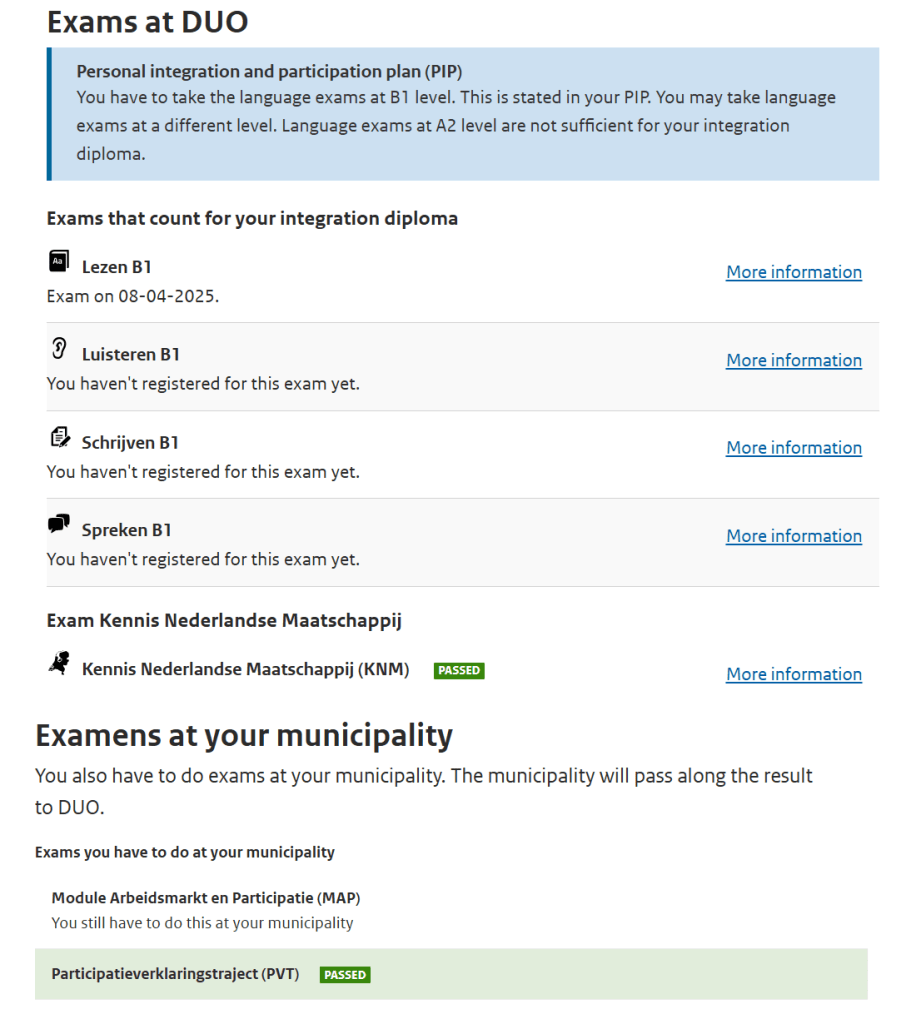
    My experience: I’m following the B1 route. My PIP requires me to pass Dutch language exams (Listening, Reading, Speaking and Writing) and Knowledge of Dutch Society (Kennis Nederlandse Maatschappij, KNM) at DUO. Meanwhile, the Module Arbeidsmarkt en Participatie (MAP) and Participatieverklaringtraject (PVT) must be completed through my municipality.

    From Mijn Inburgering site. It shows the list of exams you need to take along with your results.

    Learn the Language

    Learning Dutch is part of the integration process. It also helps in daily life and securing job. You can learn through:

    📚 Paid Options – Enroll in language schools, hire a private tutor or take online courses.

    💬 Free Options – Join Taalcafé or Taalhuis programs at your local library for casual language practice.

    📖 Self-Study – Use language apps, books, and online resources to learn at your own pace.

    Check out my recommendation of study resources in Useful Links for Learning Dutch and Top Resources to Learn Dutch Effectively for Beginners


    Diploma Evaluation & Kickstarting Your Career

    Landing a job in the Netherlands can be both exciting and challenging. Before diving in, make sure your visa allows you to work. If you’re eligible, start exploring job opportunities through online platforms and networking events. The job hunt can be a rollercoaster – some find success quickly, while others face hurdles. Stay patient and persistent!

    If you’re torn between continuing your education or entering the job market, check out my guide: Should You Pursue a New Degree or Focus on Job Hunting (When Starting Fresh Abroad)?

    Diploma Evaluation (Diplomawaardering)

    In certain professions, having your foreign diploma officially evaluated is essential. Organizations like Nuffic and International Credential Evaluation (IDW) assess your qualifications and compare them to the Dutch education system.

    Start this early in your integration. Even if you’re not actively job hunting, getting your diploma evaluated is a smart move – you never know when an opportunity might arise!

    ✔️ The evaluation process is free for most immigrants.
    ✔️ Employers use these assessments to understand your education level.

    Taking this step early can give you an edge when the right job opportunity comes along!


    Everyday Essentials to Make Your Life Easier in the Netherlands

    🚆 OV-chipkaart – Your key to public transport! Use it for trains, buses, trams and the metro.

    🚲 Bicycle – The ultimate Dutch way to get around. Invest in a sturdy (but not necessarily new) bike and make sure to learn the traffic rules!

    📱 Must-Have Apps

    • Buienradar – Stay ahead of sudden rain showers (because Dutch weather loves surprises!).
    • NS & 9292 – Plan your trips by train, bus, tram or metro with ease.
    • Marktplaats – Buy and sell second-hand goods, from furniture to bikes.

    👥 Online Support Groups – Join expat communities on Facebook for tips, advice, and local connections.


    Moving to the Netherlands comes with its challenges, but with the right preparation, you’ll settle in smoothly. Wishing you a smooth and exciting start to your new adventure – Welcome to the Netherlands! 🇳🇱😊